
RetirementCalculators.com.au
https://retirementcalculators.com.au/rent-assistance/ · Printed
Rent Assistance: How Much You Can Get and How It Works
Rent Assistance is one of the most useful — and most under-claimed — payments in the Centrelink system. If you're renting and on a Centrelink payment, you're probably eligible for some Rent Assistance on top of your existing payment. But the formula is more nuanced than most people realise: there's a rent threshold (below which you get nothing), a sliding scale in the middle, and a rent ceiling (above which extra rent doesn't help). This page walks through how the three zones work, who qualifies, the current rates, and the misconceptions that catch people out.
What's covered on this page
The three rent zones (below threshold, the 75-cent taper zone, and above ceiling), who qualifies and who doesn't, the current rates for singles and couples, two worked examples, and the four common misconceptions that cost people money.
The Headline Numbers
Rates and thresholds effective from 20 September 2026. Rent Assistance is indexed twice yearly, on 20 March and 20 September.
Key Point 1: The Three Rent Zones
Rent Assistance has three zones based on how much rent you pay. Knowing which zone your rent falls into tells you exactly what to expect. The zones are defined by two specific dollar figures — the rent threshold and the rent ceiling:
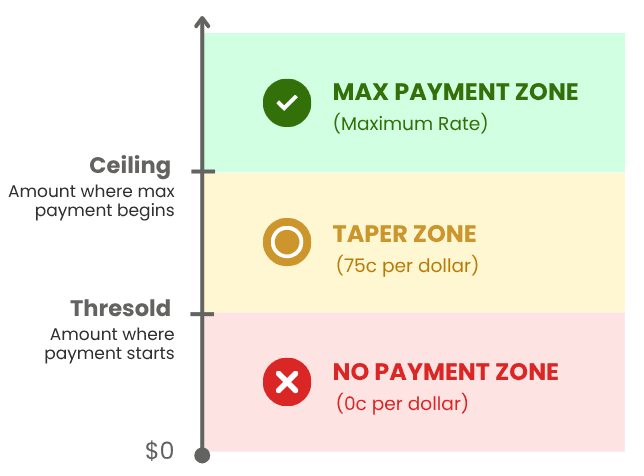
How the three zones work for a single person
The same logic applies to couples and other categories — only the threshold, ceiling, and maximum amounts change. The 75-cent taper is universal.
Key Point 2: Two Worked Examples
Two illustrative situations showing the math at work. Both use the current single and couple-combined figures from above.
Example 1: A single pensioner paying $300/fortnight rent
🧮 Single, $300/fortnight rent
Example 2: A couple paying $400/fortnight rent (combined)
🧮 Couple sharing one home, $400/fortnight combined rent
All figures above update automatically with the engine. The $300 and $400 rent figures are illustrative — your situation will use your own actual rent.
💡 What about illness-separated couples?
If a couple is illness-separated (e.g. one partner in long-term residential care), each partner is assessed against the single threshold, ceiling and maximum on their own rent. So an illness-separated couple may receive Rent Assistance calculated on each separate rent paid, rather than as one combined household. The same applies to "temporarily separated" couples and partners separated due to imprisonment. Centrelink confirms which category applies based on your specific circumstances.
Key Point 3: Who Qualifies (and Who Doesn't)
Rent Assistance has two layers of eligibility — you must qualify for an underlying Centrelink payment, AND you must meet the rent-related criteria.
You'll generally qualify if you
- Receive an eligible Centrelink payment (Age Pension, JobSeeker, DSP, Carer Payment, etc.)
- OR receive Family Tax Benefit Part A above the base rate
- Pay rent above the relevant threshold for your situation
- Live in a private rental, community housing, or similar
- Are an Australian resident, residing in Australia
You won't qualify if you
- Aren't receiving an eligible Centrelink payment
- Pay rent below the threshold
- Live in state or territory government public housing (already subsidised)
- Are a homeowner paying mortgage (mortgage isn't rent)
- Are temporarily away from your main residence (some exceptions apply)
What counts as "rent" for Rent Assistance
Centrelink takes a broad view of rent. The following are typically all assessable:
- Rent paid to a private landlord or property manager
- Rent paid to a community housing provider
- Caravan park site fees and mooring fees (for people living on a boat)
- Retirement village service fees and similar regular accommodation costs
- Manufactured home park site fees
- Board and lodging — usually two-thirds of the total amount, if the lodging portion can't be separately identified
The single sharer rate
If you share accommodation with someone other than your partner or dependent child (e.g. an unrelated housemate), you typically receive the single sharer rate, which is approximately two-thirds of the standard single maximum (currently $149.20 versus the full single maximum of $223.80). This catches people out — a single pensioner sharing with a friend gets less than a single pensioner living alone, even if their actual rent is the same. The rules vary depending on who you share with; sharing with a parent, sibling, or close family member sometimes triggers different treatment.
The Full Rate Table
The thresholds, ceilings and maximums are indexed twice yearly — on 20 March and 20 September — in line with the Consumer Price Index. Current values come straight from the DSS rates list.
| Family situation | Threshold | Ceiling | Maximum RA |
|---|---|---|---|
| Single | $157.80 | $456.20 | $223.80 |
| Single, sharer | $157.80 | $356.74 | $149.20 |
| Couple, combined | $255.80 | $537.14 | $211.00 |
| Partnered, illness-separated | $157.80 | $456.20 | $223.80 |
| Partnered, temporarily separated | $157.80 | $439.14 | $211.00 |
| Family with dependents: different rules and rates apply, paid through Family Tax Benefit Part A. See Services Australia. | |||
The Four Misconceptions That Cost People Money
"It's a separate payment I have to apply for"
Reality: it's a top-up, applied automatically
Rent Assistance is added to your existing Centrelink payment automatically once you tell Services Australia about your accommodation costs. There's no separate application form — it's built into your base payment claim, or into your accommodation update through myGov.
"My rent is above the threshold so I get the maximum"
Reality: only rent at or above the ceiling triggers the maximum
The threshold is where the payment starts, not where it's at full rate. Between the threshold and the ceiling, you receive 75 cents for every dollar of rent above the threshold. To get the full maximum, your rent needs to reach the ceiling — for a single person currently $456.20 per fortnight.
"Public housing rent counts the same as private rent"
Reality: state-government public housing rent is excluded
If you pay rent to a state or territory government housing authority, your rent is already subsidised by the government and Rent Assistance doesn't apply. Community housing (which is non-government) is generally fine.
"My partner and I should report rent separately"
Reality: couples sharing a home are assessed on combined rent
For a couple sharing a home, the rent threshold and maximum are couple-rate figures (combined). The Rent Assistance is then split between the two partners' payments. You don't report rent twice — once for the household, calculated against couple thresholds. The exception is illness-separated or temporarily-separated couples, who are each assessed against the single rates.
How to Claim Rent Assistance
The claim is mostly automatic, but you need to make sure Centrelink has your accommodation details:
- Check you're receiving an eligible base payment. Age Pension, JobSeeker, DSP, Carer Payment, Carer Allowance, FTB Part A above base — see the eligibility list above.
- Update your accommodation details through myGov. Log in, go to Centrelink → "Update my details" → "Accommodation". Enter your current rent amount, accommodation type, and tenant arrangement.
- Provide proof of rent if asked. Centrelink may request a rental agreement, rent receipts, or similar evidence.
- Wait for the payment. Once approved, Rent Assistance is added to your next regular Centrelink payment automatically.
- Update Centrelink within 14 days if your rent or living arrangement changes. A rent increase (or decrease) means a different Rent Assistance amount.
The 14-day reporting rule applies
If your rent changes, your living arrangement changes, you move house, or your relationship status changes, you must notify Centrelink within 14 days. Failure to update can result in Rent Assistance overpayments that you'll have to repay, or underpayments that aren't backdated. Updates take a few minutes through myGov.
Frequently Asked Questions
Is Rent Assistance a separate Centrelink payment?
No. Rent Assistance is a top-up paid alongside an existing eligible Centrelink payment, not a standalone payment. To get it, you must first qualify for and be receiving a payment like the Age Pension, JobSeeker, Disability Support Pension, Carer Payment, or Family Tax Benefit Part A above the base rate. Rent Assistance is then added to your existing fortnightly payment.
What if my rent is below the threshold?
If your fortnightly rent is at or below the threshold for your situation, you receive zero Rent Assistance. The payment only kicks in once you pay above the threshold. From there, you receive 75 cents for every additional dollar of rent — up to the maximum cap, which is reached at the rent ceiling.
What's the difference between the rent threshold and the rent ceiling?
The threshold is the rent level at which Rent Assistance starts. Below it, you get nothing. The ceiling is the rent level at which you reach the maximum payment. Between the two figures, you receive 75 cents for every dollar of rent above the threshold. Above the ceiling, you receive the maximum and additional rent doesn't increase your payment.
Why don't public housing tenants get Rent Assistance?
If you pay rent to a state or territory government housing authority, your rent is already subsidised by the government — Rent Assistance is designed for people in private rentals where there's no other subsidy. Tenants of community housing typically still qualify (community housing isn't government-owned), but specific arrangements vary.
What if I share accommodation with someone other than my partner?
If you share with someone other than a partner or dependent child, you typically receive the single sharer rate, which is approximately two-thirds of the standard single maximum. The rules depend on who you share with and how the rent is split — for example, sharing with a parent or sibling triggers different treatment than sharing with an unrelated housemate. Centrelink can confirm based on your specific arrangement.
Where to Next
Rent Assistance is one of the easier Centrelink payments to navigate once you understand the three zones. The key questions for your situation are: am I receiving an eligible base payment, is my rent above the threshold, and how close to the ceiling does my rent go? For most retirees on the Age Pension renting privately, the answer is yes to the first two, and the assistance is added automatically. The main things to watch are the sharer rules, the difference between threshold and ceiling, and the 14-day reporting requirement when your rent changes.
Renting on a Pension? Make Sure You're Claiming What's Yours
If you're renting and on a Centrelink payment but not currently receiving Rent Assistance, log into myGov and check your accommodation details — you may be missing out on a meaningful boost to your fortnightly income.
Accuracy Note: Whilst every effort has been made to provide current and accurate information, I am only one person and there's a very good chance that I'll miss something. If you spot a factual error, or if a calculator breaks or gives incorrect answers, I'd be really grateful if you could let me know via the Contact Us page so I can fix it ASAP.
It would speed up the correction process enormously if you could cite for me the title of the page where you find the error and describe what the error is. Thanks heaps for your support in keeping this valuable resource up to date for everyone's benefit.
Last reviewed: 9 May 2026 · All figures pulled live from the RC Data Engine. For previous indexation periods, see the Centrelink Rates & Thresholds reference page.