

Funeral Bonds, Prepaid Funerals & Burial Plots: How Centrelink Treats Each One
Three different funeral-prearrangement products, three different sets of Centrelink rules. The differences matter — choosing the right one can boost your Age Pension by hundreds or thousands of dollars a year, while choosing the wrong combination can quietly void an exemption you thought you had. This guide explains how each product is treated, the trap most people don't see coming, and which approach makes most sense for you.
⚠️ Read this first — the biggest trap
If you have both a funeral bond and a separate prepaid funeral plan, the funeral bond will generally lose its Centrelink exemption — it becomes a fully assessable financial asset subject to deeming. The two exemptions don't stack in most cases. If you're considering moving from a bond to a prepaid plan (or vice versa), get advice first — you can lose tens of thousands in exempt-asset status with a single signature.
The three products at a glance
"Funeral bond" and "prepaid funeral" get used interchangeably in everyday conversation, but they're completely different products under Centrelink rules. Here's the quick orientation:
🏦 Funeral Bond
An investment, usually through a friendly society or life insurer. You deposit money; it grows tax-paid; when you die, the proceeds are released to your estate or funeral director. You haven't chosen a funeral provider or paid for a specific funeral.
⚱️ Prepaid Funeral
A contract with a funeral director. You pay in advance for a specific funeral arrangement at today's prices; the funeral home guarantees the services regardless of future costs. The funeral itself is fully pre-arranged.
🪦 Burial Plot
The physical land or interment right — cemetery plot, mausoleum space, crypt, or burial vault. Purchased separately from the funeral itself. Can be held alongside either Option 1 or Option 2.
⚠️ Funeral insurance is something different again
Many retirees confuse funeral insurance with funeral bonds — they're not the same thing, and the Centrelink treatment is very different.
Funeral insurance is a life-insurance-style product where you pay ongoing premiums and your nominated beneficiary receives a payout when you die. Unlike funeral bonds and prepaid funerals:
- Premiums often continue for life
- Total premiums paid can sometimes exceed the eventual payout
- The policy can lapse if premiums stop
- There's generally no Centrelink exempt-asset treatment — funeral insurance doesn't qualify for the funeral bond exemption
If you're not sure which product you have, check the paperwork: a funeral bond is an investment with a friendly society or life insurer; a prepaid funeral is a contract with a specific funeral director; funeral insurance is an ongoing-premiums policy that pays a benefit on death. This page covers the first two — funeral insurance is a separate consumer product with separate rules.
The Centrelink treatment, side by side
| Product | Exempt from assets test? | Limit | Income test? |
|---|---|---|---|
| Funeral Bond | Yes — up to the threshold | $16,250 per person, max 2 bonds | Not deemed |
| Prepaid Funeral | Yes — in full | No upper limit | Exempt |
| Burial Plot | Yes — in full | Generally no upper limit (per person) | Not applicable |
That table tells most of the story. Now let's walk through each in more detail — especially the funeral-bond-vs-prepaid trap that catches a lot of people out.
Funeral bonds: the basics
A funeral bond is an investment specifically designed to fund your future funeral. You pay in once (or over time), the bond grows tax-paid until your death, and then the accumulated value is paid out to your estate or directly to your funeral director.
The current threshold (the IFBAL)
A note on "per person": the threshold applies to each individual investor where bonds are held separately. A single joint bond held in both names is capped at the same threshold, not doubled — see the couples section below.
The threshold is the amount you can invest — not the bond's current balance. This is an important distinction:
- If you invested an amount just under the threshold a couple of years ago and accumulated earnings have grown the balance to just above the threshold, your bond remains fully exempt. The amount you contributed stayed within the threshold; growth above the threshold doesn't void anything.
- If you exceeded the threshold in a single contribution (for example, by misreading the current limit and investing too much), the entire balance (including any earnings) is assessable as a financial asset and is subject to deeming under the income test.
Two bonds maximum, per person
You can hold up to two funeral bonds — but the combined investment across both must stay under the threshold. So if you hold a $10,000 bond and add a second $8,000 bond, you've exceeded the $16,250 limit and lost the exemption on both.
Couples: separate bonds beat a joint one
This is one of the more underused opportunities in the funeral-bond space:
- Each member of a couple can hold their own funeral bond up to the full threshold. Two separate bonds at $16,250 each = approximately $31,500 in exempt assets.
- A single joint bond held in both names is treated as one bond and capped at the same single threshold — $16,250 total, not doubled.
If you're a couple and already hold a joint bond, this is worth reviewing — restructuring to two separate bonds adds another full threshold of exempt assets, which at current rates can translate to potentially up to around $1,228 a year in additional pension, depending on your existing assets-test position.
Earnings are also exempt from the income test
While the bond is exempt under the assets test, the exempt funeral investment is also not subject to deeming under the income test. (Centrelink generally assesses financial assets using deeming rather than your actual earnings, so this is the relevant point.) You don't need to report bond earnings in your tax return either — they're tax-paid at the friendly society or life insurer level. This makes them genuinely "set and forget" for pension purposes.
Prepaid funerals: the basics
A prepaid funeral is a contract with a specific funeral director. You pay in advance — either as a lump sum or by instalments — for the funeral services you've specified. The funeral director guarantees that the funeral as agreed will be provided at the time of your death, regardless of how much costs have risen.
Unlimited exemption
For Centrelink purposes, the amount you've paid for a prepaid funeral is fully exempt from the assets test — there's no upper limit. If you've paid $40,000 for a fully-featured funeral, that $40,000 is exempt. The earnings on those funds (held in trust by the funeral director) are also exempt from the income test.
The conditions are essentially:
- You've entered a written contract with a funeral director
- The funeral services to be provided are specified
- The payment is not refundable (with one exception: if you move outside the funeral director's service area)
- Nothing further needs to be done for the services to be delivered when needed
💡 Why prepaid funerals are so powerful for pension purposes
Because there's no cap, a prepaid funeral can shift a much larger amount out of your assessable assets than a funeral bond can. If you have, say, $50,000 sitting in a term deposit and you commit it to a prepaid funeral arrangement, you've removed $50,000 from your assets test in one move. At the standard taper rate ($3.00 per $1,000 per fortnight over the threshold), that could mean up to $150 per fortnight in extra pension — $3,900 a year. The catch is that the money is genuinely committed: you can't change your mind and get it back.
Burial plots: the simplest exemption
A burial plot is fully exempt from the assets test — this includes a cemetery plot, family mausoleum, crypt, or burial vault. Each member of a couple can have their own exempt plot, and there's no monetary limit.
Unlike funeral bonds and prepaid funerals, the burial plot exemption is largely uncontroversial — you can hold a plot alongside either a funeral bond or a prepaid funeral without any interaction effects. So if you're considering pre-arrangements, the plot is the easiest place to start: it's exempt, it's permanent, and it doesn't complicate anything else.
The big trap: funeral bond + prepaid funeral together
Now we get to the issue that catches the most people out. The funeral bond exemption is conditional on the bond not relating to a funeral for which prepaid expenses have been paid. In other words:
⚠️ The rule, plain English
If you already have a funeral bond and then sign up for a separate prepaid funeral contract, your existing funeral bond will generally lose its Centrelink exemption. It becomes a fully assessable financial asset and is subject to deeming for the income test. The two exemptions do not stack in most cases.
This isn't a quirk — it's built into the social security legislation. The reasoning is straightforward: the funeral bond exemption exists to help people who otherwise can't afford to pre-arrange a funeral with a director. If you've already prepaid a funeral, you don't need the bond exemption for the same purpose.
The one exception: bonds assigned to the funeral director
There is a way to keep things tidy. If your funeral bond is formally assigned to the funeral director as the means of paying for your prepaid funeral, the bond and the prepaid arrangement become part of one combined plan — and the unlimited prepaid funeral exemption applies to the whole thing. Many funeral directors offer this structure precisely because it preserves the Centrelink treatment.
The mechanics: the bond stays with the friendly society or insurer, but legally the proceeds are pre-promised to the funeral director under your prepaid contract. On your death, the bond pays out directly to the funeral director and covers the cost.
If you're considering a prepaid funeral and you already have a funeral bond, ask your funeral director whether they accept bond assignment — many do. This preserves the exemption you've already built up.
The reverse trap: starting a prepaid funeral when you have a bond
The trap generally fires in either direction. If you have a $15,000 funeral bond (exempt) and you sign a $20,000 prepaid funeral contract separately, your situation overnight becomes: prepaid contract exempt (good); funeral bond now assessable as a $15,000+ financial asset (bad). At the standard taper, that's potentially $45 per fortnight ($1,170/yr) less pension on the bond alone — for an outcome that wasn't intended.
The fix is almost always to assign the bond to the funeral director as part of the prepaid plan, or to surrender the bond and roll the proceeds into the prepaid contract. Get advice before signing anything — reversing these decisions can be difficult or impossible.
Which approach makes sense for you?
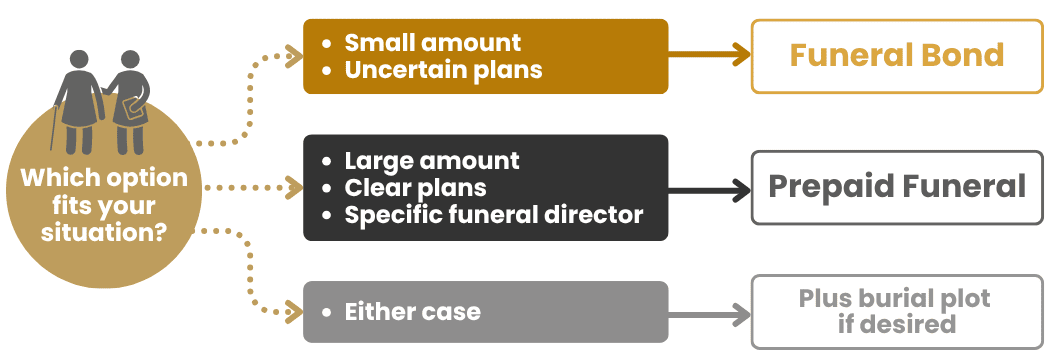
The right product depends on your circumstances. Some rough guidance:
Consider a funeral bond if…
- You want to set aside a moderate amount (up to $16,250 per person) but haven't decided which funeral director you'd use
- You value flexibility — the bond proceeds can go to whatever funeral arrangement your family chooses
- You'd rather not commit to a specific funeral package right now
- You're part of a couple and want to maximise the combined exempt amount (two separate bonds ≈ $31,500 exempt)
Consider a prepaid funeral if…
- You want to shift a larger amount (over the bond threshold) out of your assets test
- You have clear preferences and want the specific funeral services locked in at today's prices
- You're comfortable with a specific funeral director and the loss of refundability isn't a concern
- You want to give your family certainty about both the arrangements and the cost
Consider a burial plot if…
- You have clear preferences about where you'd like to be interred
- You want a small, simple, permanent pre-arrangement that doesn't complicate anything else
- You want to spare your family from having to choose under stressful conditions
Practical points worth knowing
The threshold is indexed each 1 July
The funeral bond threshold goes up each 1 July with CPI. If you've already invested up to the previous threshold, you can add another contribution each July to "top up" to the new limit without losing your exemption. The current limit is $16,250; check our current rates and thresholds page for any updates.
You can't get your money back from a prepaid funeral
The non-refundability requirement is part of what makes a prepaid funeral exempt. You can't change your mind and get the money back — if you do, it's no longer prepaid for Centrelink purposes (and may also trigger consumer-protection or contract issues with the funeral director). Plan carefully before committing larger amounts.
Buying a bond from a friendly society vs life insurer
Funeral bonds are offered by friendly societies (like Lifeplan, Sureplan, Foresters) and life insurers. The Centrelink treatment is identical regardless of provider — the difference comes in fees, performance, and member services. This is one to compare on the financial product fundamentals, not on Centrelink grounds.
Funeral bond + estate planning
A funeral bond can be nominated to a specific beneficiary or paid to your estate. If it pays to your estate, your executor uses it to pay the funeral and the remainder forms part of the estate. If it's assigned to a funeral director, the funeral director receives the proceeds directly. Talk to your solicitor about how the bond interacts with your will.
ℹ️ A note on residential aged care
Funeral bonds and prepaid funerals are generally exempt for aged-care means testing as well, although aged-care assessments use different calculation rules and have their own interactions with things like the RAD/DAP (Refundable Accommodation Deposit / Daily Accommodation Payment), net assessable assets, and gifting timing. If you're entering aged care and considering pre-arrangements, get advice that covers both the Centrelink and aged-care systems together — the optimal answer in one system isn't always optimal in the other.
Want to see how moving money into a funeral bond would affect your pension?
Model the scenario in our How Much Age Pension calculator — reduce your "other assets" by the bond amount and see the resulting pension change.
What to do next
If you're considering a funeral bond, a prepaid funeral, or a burial plot, three things matter most. First, make sure you don't accidentally combine a funeral bond with a separate prepaid funeral — that's the single biggest error people make in this space. Second, if you're part of a couple, structure things to take advantage of the per-person threshold — two separate bonds beat one joint bond. Third, treat these decisions as final: prepaid funerals aren't refundable, and bond exemptions can be quietly voided by other choices. If significant money is at stake, a single coaching call can prevent a decision that's hard to undo.
Significant funeral pre-arrangements on the table?
If you're considering moving substantial assets into a funeral bond or prepaid funeral, a coaching call can help you understand the impact on your pension before you commit. These decisions are largely irreversible — better to model them first.
Accuracy Note: Whilst every care has been taken to ensure this information is current and accurate, I am only one person and there's a very good chance I'll miss something. If you spot a factual error, or if a calculator breaks or gives an incorrect answer, I'd be really grateful if you could let me know via the Contact Us page so I can fix it as quickly as possible.
It would speed up the correction process enormously if you could cite the title of the page where you found the error and describe what the error is. Thank you for your support in keeping this resource accurate for everyone's benefit.
Disclaimer: The information on this page is general in nature only and does not take into account your individual circumstances. It is not financial advice, tax advice, or legal advice. Funeral bond and prepaid funeral decisions involve substantial money, are largely irreversible, and depend on specific product features and your personal circumstances; consult a qualified financial planner, your funeral director, and your solicitor before acting.
Primary sources: DSS Social Security Guide — 4.6.2.10 General provisions for exempt assets · Services Australia — Funeral bonds and prepaid funerals
Last reviewed: 10 September 2026 · Funeral bond threshold current as of $16,250. For previous indexation periods or other Centrelink rates, see the Centrelink Rates & Thresholds reference page.