
RetirementCalculators.com.au
https://retirementcalculators.com.au/younger-partner/carer-payment/ · Printed
Carer Payment When Your Partner Is on Age Pension
If you're under Age Pension age and providing constant care for your pensioner partner, Carer Payment could be the right option for you. It's effectively the carer's version of the Age Pension — the same fortnightly rate, the same income and assets tests — but it recognises that your work is the caring, not paid employment. This page walks through what counts as constant care, the strict 25-hour work limit, the income and assets thresholds (which match the Age Pension), and how to apply.
What's covered on this page
Eligibility for both you and the person you care for, the 25-hour work limit unique to this payment, the income and assets tests (same as Age Pension), how Carer Payment differs from Carer Allowance, and how to apply.
The Headline Numbers
Rates effective from 20 September 2026. Carer Payment uses the same fortnightly rates as the Age Pension.
Key Point 1: Carer Payment as the "Age Pension for Younger Carers"
The simplest way to think about Carer Payment is as the income-support payment for someone whose full-time job is caring for a person with severe disability, illness, or frailty. The maximum rate is identical to the Age Pension, the income and assets tests are the same, and it's not taxed. The qualifying criterion is what differs: instead of being old enough for the Age Pension, you must be providing constant care.
- Same fortnightly rate as the Age Pension
- Same means tests — combined household income and assets, with the same thresholds
- Different qualifying rule — care provided, not age reached
- Includes the Pensioner Concession Card automatically, the same as Age Pension recipients receive
✓ Couples can receive both Age Pension and Carer Payment together
If your partner is on the Age Pension and you're caring for them (or for someone else), you each receive a separate payment in your own right. The combined household income from two pension-rate payments is significantly higher than a couple-rate Age Pension alone.
Key Point 2: The "Constant Care" Requirement
Constant care is the core eligibility requirement, and it's defined more strictly than people often expect. You must be providing care that is daily, ongoing and sufficient to qualify the person you care for as a "care receiver" under Centrelink's rules.
What "constant care" includes
- Personal care — assistance with bathing, dressing, toileting, eating
- Medical management — administering medication, attending appointments
- Mobility support — assistance with movement, transfers, falls prevention
- Cognitive support — for dementia, mental illness, or intellectual disability
- Communication and decision-making support
- Behavioural management for some conditions
Care receiver eligibility
The person you care for must qualify as a Centrelink "care receiver". Eligibility covers people with:
- A severe physical disability or chronic medical condition
- A severe mental illness
- Frail-aged status with significant care needs
- An intellectual disability
The care receiver's condition must be assessed using the Adult Disability Assessment Tool (or Child Disability Assessment Tool for under-16s), which scores the level of care required. The assessment is administered through Centrelink and typically involves your treating doctor providing supporting medical evidence. The condition must be expected to last at least 6 months and require constant care during that period.
💡 If your partner is already on the Age Pension
Centrelink already has medical and circumstantial information about your partner. This generally streamlines your Carer Payment application — you may not need to gather as much fresh medical evidence. Mention your partner's Customer Reference Number (CRN) when you apply, so the assessor can connect the records.
Key Point 3: The 25-Hour Work Limit
This is the rule unique to Carer Payment, and the one that catches most people out. While receiving Carer Payment, you may work, study, volunteer, or be away from caring for no more than 25 hours per week, including travel time. This is in addition to (not instead of) the income test, which still applies to any income you earn from work.
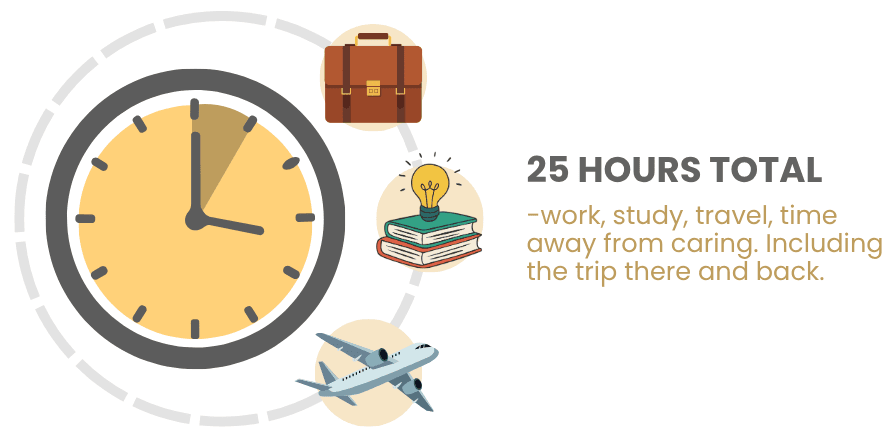
What the 25-hour limit actually counts
- Paid employment hours
- Study or training time, including online learning
- Volunteer work
- Travel time to and from any of the above
- Time away from your care receiver for any other reason
What it doesn't count
- Time when your care receiver is in respite care (separate respite rules apply)
- Time when another person is providing the care for you
- Routine activities done while caring (shopping, errands, household management)
If you exceed 25 hours
Occasional overruns aren't necessarily a problem — Centrelink looks at the pattern over time, not single weeks. But a regular pattern of exceeding 25 hours will trigger a review of your eligibility, and Carer Payment may be cancelled. If your circumstances are changing, notify Centrelink within 14 days rather than waiting for them to find out.
Income test still applies on top of the 25-hour rule
The 25-hour limit is about time; the income test is about money. Both apply simultaneously. Even if you're under the 25-hour limit, your wages may still reduce your Carer Payment under the income test — see the next section.
Income and Assets Tests
Carer Payment uses the same income and assets tests as the Age Pension, applied to your combined household figures. Whichever test produces the lower result determines your payment.
Income test
The income-free area for couples (combined) is currently $396 per fortnight. Above that, every dollar of combined income reduces your payment by 50 cents (25 cents each across both partners' payments). The Work Bonus applies to wages, the same way it does for the Age Pension.
Assets test
| Situation | Full pension up to | Cuts out at |
|---|---|---|
| Homeowner — couple combined | $499,000 | $1,121,000 |
| Non-homeowner — couple combined | $766,000 | $1,388,000 |
The principal home is exempt from the assets test, regardless of value. For full detail on what's assessable and what's not, see Assets Test Explained.
Carer Payment vs Carer Allowance: Don't Confuse These
The two payments sound similar but are very different. The most useful thing you can do is hold both clearly in mind so you can apply for the right ones.
| Carer Payment | Carer Allowance | |
|---|---|---|
| What it is | Income-replacement payment | Supplementary payment |
| Rate | Same as Age Pension ($1,237.70 single max per fortnight) | $162.60 per fortnight |
| Care level | Constant care | Daily care |
| Means tested? | Yes — same as Age Pension | Income only (family combined annual limit $250,000) |
| Can be received with other payments? | No — replaces other income support | Yes — paid on top of Age Pension, JobSeeker, etc. |
You can receive both Carer Payment and Carer Allowance simultaneously. Many full-time carers do — Carer Payment is your primary income, Carer Allowance is a small additional supplement.
How to Apply for Carer Payment
The application is more involved than most Centrelink claims because it requires medical evidence about the care receiver. Allow several weeks to gather documents and complete the assessment.
- Centrelink claim form — start through myGov, "Make a claim" → Carer Payment
- Care receiver's information — their identity, CRN if they have one, contact details
- Medical evidence — Treating Doctor's Report from the care receiver's GP, plus any specialist reports
- Adult Disability Assessment Tool — completed as part of the claim process; Centrelink will guide you
- Your income and assets details — combined household figures
For the full document checklist and form-by-form detail, see the Step-by-Step Application Guide. Carer Payment claims often take 6–10 weeks to process due to the medical assessment component.
Frequently Asked Questions
Is Carer Payment the same as Carer Allowance?
No — they're two different payments and you can receive both at the same time. Carer Payment is an income-replacement payment at the same rate as the Age Pension, for people providing constant care. Carer Allowance is a smaller supplementary payment for people providing daily care, paid in addition to other income or payments. Many carers receive both.
Can I work while receiving Carer Payment?
Yes, but with a strict limit. You can work, study, volunteer, or be away from caring for up to 25 hours per week (including travel time). If you exceed 25 hours regularly, your Carer Payment may be reviewed. The income from your work is also assessed under the income test, which can reduce your payment further.
Does my partner have to be physically disabled to qualify as a care receiver?
Not necessarily. Care receiver eligibility covers people with a severe physical disability, severe medical condition, severe mental illness, or who are frail-aged. Centrelink uses an Adult Disability Assessment Tool to score the level of care needed. The condition must be expected to last at least 6 months and require constant care.
How is Carer Payment affected by my partner's Age Pension?
Carer Payment uses the same income and assets tests as the Age Pension, applied to your combined household figures. Each partner is assessed separately for their own payment, but both assessments use combined-couple thresholds. Your partner's Age Pension and your Carer Payment are independent payments that can be received simultaneously.
What happens to Carer Payment when the person I care for passes away?
Carer Payment continues for 14 weeks after the death of the care receiver — this is a bereavement period to give the carer time to adjust. After that, you'll need to look at other payment options if you're still under Age Pension age. Centrelink can guide you through the transition.
Where to Next
Carer Payment is one of the most generous Centrelink payments available to people under Age Pension age — same rate as the pension, with the Pensioner Concession Card included. The catches are the strict 25-hour rule and the requirement that your care receiver qualifies medically. If both fit your situation, the application is well worth the effort. If your level of care doesn't quite meet the constant-care threshold, look at Carer Allowance instead — it's smaller but easier to qualify for, and can be received alongside JobSeeker or other payments.
Caring for Someone? Get Tailored Advice
Book a coaching call to walk through your specific situation — whether your care meets the constant-care threshold, the 25-hour math for your work, and what your combined household pension would look like.
Accuracy Note: Whilst every effort has been made to provide current and accurate information, I am only one person and there's a very good chance that I'll miss something. If you spot a factual error, or if a calculator breaks or gives incorrect answers, I'd be really grateful if you could let me know via the Contact Us page so I can fix it ASAP.
It would speed up the correction process enormously if you could cite for me the title of the page where you find the error and describe what the error is. Thanks heaps for your support in keeping this valuable resource up to date for everyone's benefit.
It would speed up the correction process enormously if you could cite for me the title of the page where you find the error and describe what the error is. Thanks heaps for your support in keeping this valuable resource up to date for everyone's benefit.
Last reviewed: 12 September 2026 · All figures pulled live from the RC Data Engine. For previous indexation periods, see the Centrelink Rates & Thresholds reference page.