
RetirementCalculators.com.au
https://retirementcalculators.com.au/health-care-cards/commonwealth-seniors-health-card/ · Printed
Commonwealth Seniors Health Card: For Self-Funded Retirees
If you've reached Age Pension age but don't qualify for the pension because your assets are too high, the Commonwealth Seniors Health Card is specifically for you. It's the card that fills the gap for self-funded retirees — people who've planned and saved enough to fund their own retirement, but who would still benefit from concession-rate prescriptions and bulk-billed GP visits. This page walks through the income-only test, what the card actually unlocks, and the application process.
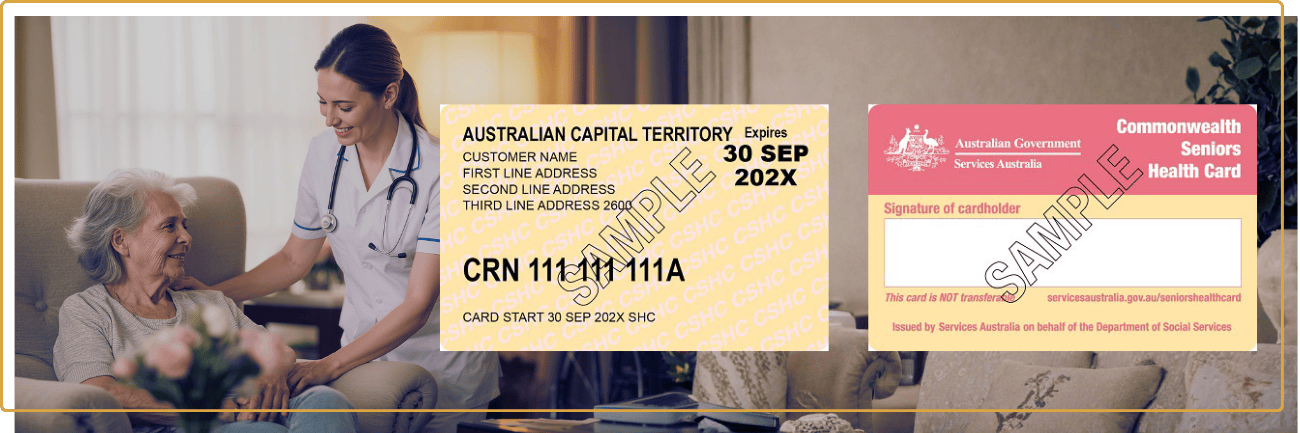
What's covered on this page
How Adjusted Taxable Income works for the CSHC, why the no-asset-test rule matters for self-funded retirees, what the card unlocks at federal and state level, and how to apply through myGov.
The Headline Numbers
Income limits effective from 20 September 2026. Limits are indexed annually on 20 September.
Key Point 1: Why the CSHC Exists, and the No-Assets-Test Advantage
The CSHC was created specifically for retirees who fall into a particular gap — old enough for the Age Pension on age grounds, but with too much in assets to qualify for the pension itself. Without the CSHC, this group would have no government concession card at all, despite often facing the same medication and healthcare costs as pensioners.
The single most important rule about the CSHC: there is no assets test. Unlike the Age Pension, which considers both income and assets, the CSHC looks only at your income. You can have substantial savings, super balances, investment property and share portfolios, and still qualify — provided your Adjusted Taxable Income stays under the threshold. This is what makes the card so valuable to people who've been disappointed by failing the pension assets test.
✓ Lost the pension? Check the CSHC
If your income or assets recently rose above the pension cut-off — perhaps after an inheritance, downsizing, or a strong year on investments — the CSHC may apply even though the pension doesn't. Run the eligibility check. Many people in this situation don't realise the card exists.
Key Point 2: How Adjusted Taxable Income Works
Adjusted Taxable Income (ATI) is a Centrelink-specific calculation. It's not the same as your taxable income alone, and it's not the same as cash flow. Understanding it is the single most useful thing a retiree can do before applying.
The ATI formula
Adjusted Taxable Income components
Note that lump sums (inheritances, one-off windfalls) generally aren't included in ATI in the year received — though if invested, the resulting earnings will appear in subsequent years. Two specific points often work in retirees' favour: super in accumulation phase generally doesn't count, and account-based pensions use deeming (currently 1.75% / 3.75%) rather than your actual income from them. If your account-based pension has been earning more than these rates, ATI gives you a lower figure than your real income.
Pre-2015 grandfathering
If your account-based pension started before 1 January 2015 and you've held the CSHC continuously since then, more favourable rules may apply. Your product provider or a financial planner can confirm.
Key Point 3: What the CSHC Actually Unlocks
The CSHC is primarily a federal card, with strong PBS and Medicare benefits but more limited state and council coverage. Setting the right expectation up-front prevents disappointment.
PBS, Medicare and federal supplements
- PBS prescriptions at the concession rate of $7.70 per script (versus the general rate of $25.00)
- PBS Safety Net — once your annual prescription spend reaches $277.20, further scripts are free
- Bulk-billed GP visits at participating practices
- Energy Supplement (a small fortnightly payment to help with electricity costs)
- Subsidised hearing services through the Hearing Services Program
Some state concessions apply (varies considerably)
State coverage for CSHC holders varies significantly by jurisdiction. Some states extend a portion of their concession scheme to CSHC holders; others reserve their main concessions for PCC holders only. Common partial extensions include:
- Public transport concession fares (varies)
- Some utility rebates (less generous than for PCC holders)
- Limited motor registration concessions
For specifics in your state, see your state concessions guide.
Council concessions generally not extended
Most council rate concessions are reserved for PCC holders. CSHC holders typically don't qualify for council rate rebates, though discounted entry to some council facilities may apply. Check directly with your local council.
💡 What you might save (indicative)
For most CSHC holders, the federal-level benefits are where the value sits — heavy prescription users see meaningful PBS savings, and bulk-billed GP visits add up over a year. State savings vary by jurisdiction; see your state concessions guide for specifics.
Should You Apply for the CSHC?
The card is worth applying for in most circumstances if you qualify, but there are situations where it makes more sense to look at other options first. Here's a quick decision aid:
✓ Apply for the CSHC if:
- You're at Age Pension age and don't qualify for the pension
- Your Adjusted Taxable Income is under the threshold
- Your account-based pension has been earning above the deeming rates (deeming may give you a lower ATI than expected)
- You're paying full-price for prescriptions and would benefit from the concession rate
⚠️ Check these other options first:
- If you might qualify for any Age Pension at all, even a small part-pension — the Pensioner Concession Card is automatic with the pension and gives broader benefits than the CSHC. Run the Age Pension calculator first.
- If you're under Age Pension age, the CSHC isn't available to you. Look at the Low Income Health Care Card instead.
- If your ATI is borderline, talk to a financial planner about strategies that may reduce it — though the cost of advice should be weighed against the savings the card delivers.
How to Apply for the CSHC
Most claims are decided within 4–8 weeks, and the card is backdated to your lodgement date. Before applying, make sure you've lodged your most recent tax return — Centrelink uses ATO-shared data to verify your ATI, so without a current return the assessment can't be completed. Then start the claim through myGov, selecting "Make a claim" → Commonwealth Seniors Health Card. For the full document checklist and form-by-form detail, see the Step-by-Step Application Guide.
Once you have the card, there's no separate renewal you need to apply for. Centrelink reviews your ATI annually based on tax return data the ATO shares automatically — as long as your ATI stays under the threshold, your card continues.
How the CSHC Compares With the Other Cards
| Card | For whom | Income test | Assets test? |
|---|---|---|---|
| Pensioner Concession Card (PCC) | Pension recipients | Tied to Age Pension means tests | Yes (via pension) |
| Low Income Health Care Card (LIHCC) | Working-age, low income | 8-week weekly average — single $826 / couple $1,410 | No |
| Commonwealth Seniors Health Card (CSHC) | Self-funded retirees over Age Pension age | Annual ATI — single $105,048 / couple $168,076 | No |
About state concession amounts
CSHC state coverage varies considerably by jurisdiction — more than for the PCC. Use this page for the framework and the federal-level figures (which are the same Australia-wide); for the specific state-level concessions that apply where you live, check your state's concessions guide.
Frequently Asked Questions
What is Adjusted Taxable Income for the CSHC?
Adjusted Taxable Income (ATI) is your taxable income from your most recent tax return, plus several add-backs: reportable employer superannuation contributions, reportable fringe benefits, total net investment losses, and deemed earnings on account-based pensions. It's not the same as your taxable income alone, and it's not the same as cash flow — it's a Centrelink-specific calculation.
Does my super count towards the CSHC income limit?
Super in accumulation phase generally doesn't count. Once your super is in pension phase (an account-based pension), Centrelink applies deeming to the balance — meaning ATI includes a deemed return on the account, not the actual amounts you withdraw. This often gives a lower income figure than retirees expect, particularly when investment returns have been strong.
Is there any asset test for the CSHC?
No. The CSHC has no asset test at all — only an income test based on Adjusted Taxable Income. You can have substantial savings, super and property and still qualify, provided your ATI is under the threshold. This is what makes the card valuable to self-funded retirees who don't qualify for the Age Pension because their assets are too high.
How is the card renewed each year?
Centrelink reviews your ATI annually based on your most recent tax return data, which the ATO shares with them automatically. There's no separate renewal application unless something changes in your circumstances. If your income remains under the threshold, your card continues. If it rises above, you'll be notified that the card will not be renewed.
Will the CSHC give me the same state concessions as the PCC?
No — fewer state concessions apply to CSHC holders compared to the Pensioner Concession Card. The CSHC is primarily a federal card giving access to PBS prescriptions at the concession rate and bulk-billed GP visits. Some states extend a portion of their concession scheme to CSHC holders but you generally don't get the same breadth as a pension card holder. See your state's concessions guide for specifics.
Where to Next
The CSHC is a deliberately narrow card — designed for one specific group of retirees, with one test and one main set of benefits. If you're in that group, it's worth applying for: the federal-level savings on prescriptions and GP visits add up reliably over a year. If you're not yet sure whether you qualify, the eligibility calculator runs the ATI check for you in a few minutes.
Find Out If You Qualify in Five Minutes
The eligibility calculator runs the ATI test for you — and screens you for all three cards at once.
Accuracy Note: Whilst every effort has been made to provide current and accurate information, I am only one person and there's a very good chance that I'll miss something. If you spot a factual error, or if a calculator breaks or gives incorrect answers, I'd be really grateful if you could let me know via the Contact Us page so I can fix it ASAP.
It would speed up the correction process enormously if you could cite for me the title of the page where you find the error and describe what the error is. Thanks heaps for your support in keeping this valuable resource up to date for everyone's benefit.
Last reviewed: 9 May 2026 · All figures pulled live from the RC Data Engine. For previous indexation periods, see the Centrelink Rates & Thresholds reference page.