

The Centrelink 5 Acre Rule: How Large Properties Affect Your Home Exemption
If your property is on acreage, understanding the Centrelink 5 acre rule is essential for your Age Pension. Officially known as the private land use test, this rule determines how much of your rural property qualifies for the principal home exemption under the assets test — and how any excess land beyond 2 hectares is valued and counted against your pension entitlement.
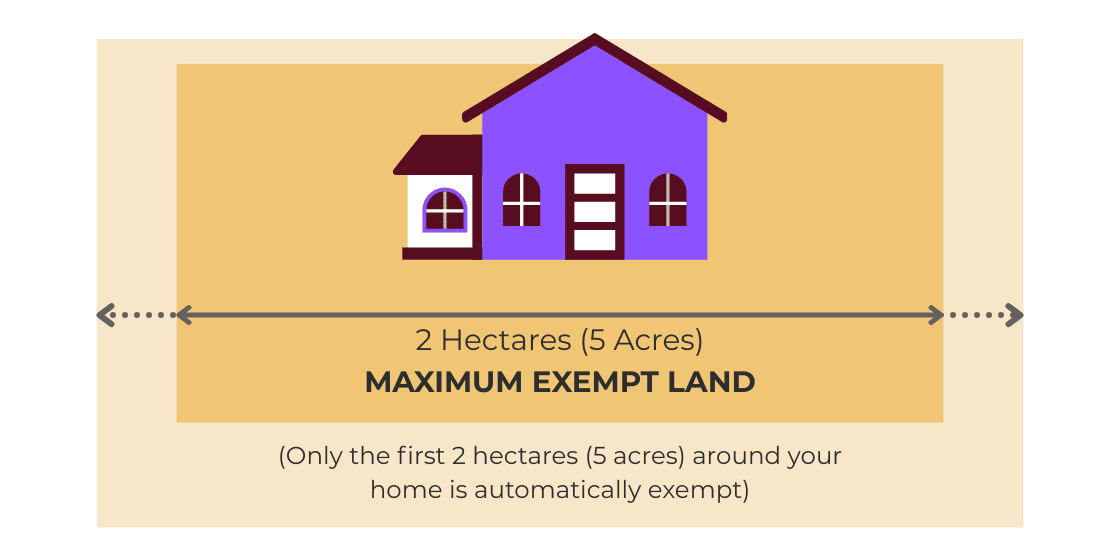
The basic rule: 2 hectares (5 acres) around your home
Under the Centrelink assets test, your principal home is generally exempt — it doesn't count when calculating your pension. But for properties on larger blocks, there's a limit to how much land that home exemption covers.
The private land use test (commonly known as the Centrelink 5 acre rule or 2 hectare rule) works like this:
✅ 2 hectares or less
If your entire property is 2 hectares (approximately 5 acres) or less on a single title, and the land is used primarily for private or domestic purposes, the whole property is exempt from the assets test.
⚠️ More than 2 hectares
If your property exceeds 2 hectares, only your home and the surrounding 2 hectares (used for domestic purposes) is exempt. The remaining land — what Centrelink statements call your "curtilage" — is an assessable asset at its current market value.
💡 What "curtilage" means on your Centrelink paperwork
This is one of those terms that gets used differently in different places. The formal regulatory definition (in the legislation) is "land adjacent to the principal home" — all of it, including whatever's exempt. But on the letters and statements Centrelink actually sends you, "curtilage" is generally used to mean the assessable excess land — the bit beyond your exempt 2 hectares that they're counting against your assets test.
Throughout this page we use the Centrelink-statement meaning, because that's the language you'll see on your own paperwork:
- "Home" (or "home and exempt land") = the house plus the exempt land around it — up to 2 hectares under the standard rule, or your entire property under the 20-year rule.
- "Curtilage" = the assessable land beyond what's exempt. This is what Centrelink will value and count against your pension.
Why this matters: the assets test context
The 5 acre rule only matters because excess land becomes an assessable asset. Your assessable assets are tested against thresholds — if they exceed the relevant threshold, your pension reduces by $3 per fortnight for every $1,000 over. Push past the upper cut-off, and your pension stops entirely.
For a homeowner, the assets test thresholds start at — (single) or — (couple). The pension stops entirely at — (single) or — (couple). See our Assets Test Explained guide for the full picture.
This is why people on acreage take the 5 acre rule seriously. If your excess land is worth several hundred thousand dollars, it can comfortably move you from full pension to part pension — or part pension to no pension at all.
What counts as "private or domestic" use?
For the 2-hectare exempt area around your home to qualify, the land must be used primarily for private or domestic purposes. This is a broad test, and most residential use qualifies. Examples include:
- Your house, garden, lawn, and outdoor living areas
- Driveways, garages, carports
- Personal sheds, workshops, or studios (not commercial)
- Swimming pools, tennis courts, and recreation areas
- Keeping a few chickens, a horse for pleasure, or a vegetable garden for personal use
- Land used occasionally for community purposes, even if a token payment is received
The key word is "primarily." If you have a small home office within your house that's also used for personal purposes, the whole house still qualifies. But if a significant portion of your property is used exclusively for commercial purposes, that portion may be assessed separately.
⚠️ Commercial use changes the calculation
If part of your home or exempt land is used exclusively for commercial purposes, that portion becomes assessable. For example, if you run a business from home and 40% of the floor space is used solely for the business, that 40% of your home's value becomes an assessable asset. This applies even to properties under 2 hectares.
How excess land beyond 2 hectares is valued
If your rural property exceeds 2 hectares and you don't qualify for the extended land use test (the 20-year rule), Centrelink will count the value of your excess land as an assessable asset. But the way that value is calculated is not as straightforward as most people assume.
The correct method requires two separate market valuations — one for the entire property, and one for just the home plus 2 hectares — with the difference being the assessable amount. This subtraction method is established by tribunal case law, and it often produces a lower assessable value than you might expect, particularly where the excess land is steep, restricted, or has limited development potential.
💡 This is worth understanding — it could reduce your assessable assets
Many people assume their excess land is worth more than it actually is under this calculation. We've put together a detailed guide that walks you through the 3-step valuation process, worked examples, how to get a proper appraisal from a local real estate agent (including draft instructions you can copy and give them), and what to do if you disagree with Centrelink's valuation.
Read our full guide: How to value excess land on your property →
Multiple titles: a common complication
The Centrelink 5 acre rule applies to land on the same title as your home. If your property is spread across multiple titles, things get more complex:
| Situation | How it's assessed |
|---|---|
| Single title, under 2 hectares | Fully exempt (assuming private/domestic use) |
| Single title, over 2 hectares | Home + 2-hectare exempt area; remainder (curtilage) assessable |
| Home on Title A, adjacent land on Title B | Generally, only Title A qualifies for the home exemption. Title B is assessed as a separate asset at full market value |
| Home straddles two titles | Both titles may be treated as one for the exempt-area assessment |
There are three exceptions where land on a separate title can still be treated as part of your principal home exemption:
- Your dwelling is physically located across both titles
- The land is protected under natural, historic, or Indigenous heritage laws
- Selling one title would seriously undermine the function of the house as a dwelling (for example, your only access road or septic system is on the other title)
ℹ️ Grandfathered multiple title exemptions
If you had your principal-home exemption extended across multiple titles before 1 January 2007, that arrangement can continue as long as the land is still used primarily for private or domestic purposes, the property remains your principal home, and your payment hasn't been cancelled since then.
Structures, sheds, and improvements on acreage
Permanent fixtures that are part of your home — built-in appliances, carpets, light fittings — are included in the home exemption. But structures used for commercial or business purposes are always assessable, regardless of where they sit on the property:
- Exempt: Personal sheds, garages, swimming pools, tennis courts, garden structures — provided they're used primarily for private purposes and are on the same title
- Assessable: Commercially-used sheds, workshops, machinery sheds, hay barns, livestock facilities, and any structure used exclusively for business — even if it sits within your exempt 2-hectare area
This is an important distinction for hobby farmers and people who run small businesses from home. The land may be exempt, but the commercial structures on it are not.
Crops, orchards, and livestock
If your property includes productive land, some special rules apply even within the 2-hectare exempt area:
- Crops not yet ready for harvest are treated as part of the land and share its exempt status (whether on exempt land or not).
- Crops ready for harvest become assessable assets, even if they're growing on your exempt land. A valuation may be needed.
- Livestock are always assessed as separate assets, regardless of where they are on the property.
- Farm machinery and equipment are always assessable assets.
The big exception: the 20-year rule
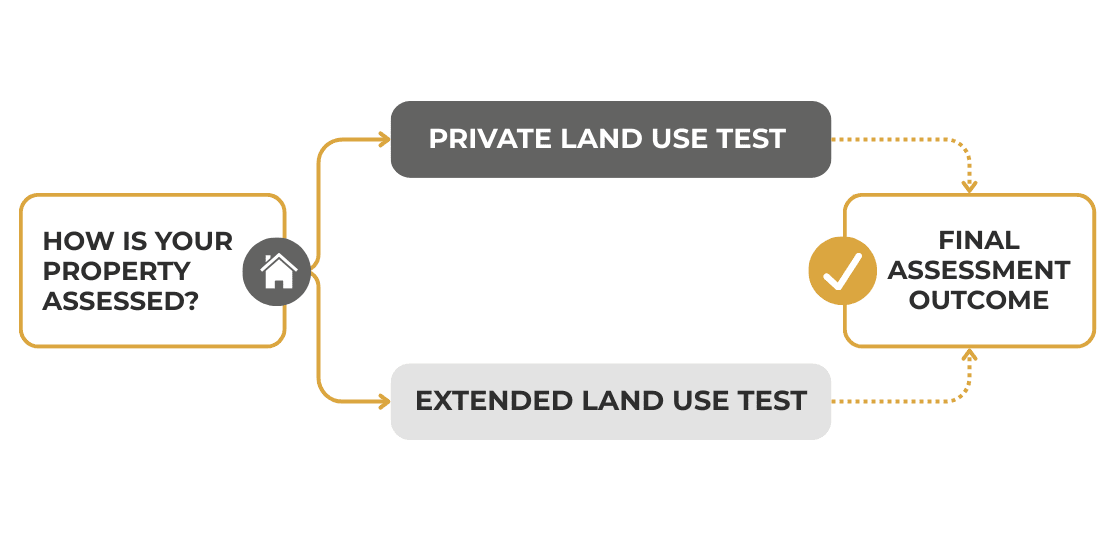
If the standard 5 acre rule means part of your property is assessable, don't stop there. The 20-year continuous attachment rule (the extended land use test) can exempt your entire property from the assets test — regardless of size — if you meet all four criteria:
- Property on a single title
- Lived there continuously for 20+ years
- Receiving Age Pension, Carer Payment, or DVA Service Pension
- The land is being used effectively (by you, someone else, or it has little or no scope for productive use)
For many long-term rural property owners, the 20-year rule provides a complete home exemption for large properties that would otherwise have significant assessable excess land under the standard 5 acre rule. Read our full guide to how the 20-year rule works and how to qualify.
Want to see how this plays out in practice?
Our 12-acre block case study walks through a real-world situation showing how the 5 acre rule and the 20-year rule interact — with the actual numbers, before and after.
Practical considerations for property owners on acreage
Thinking about downsizing?
If you're on a large rural property with assessable excess land, downsizing to a smaller home (under 2 hectares) would make your entire home exempt. The sale proceeds can also be contributed to super under the downsizer contribution rules, and the new home would be fully exempt from the assets test. If you choose to share any of the proceeds with family, remember that the gifting rules apply — only $10,000 per year (or $30,000 over 5 years) can be transferred without it counting as deprivation under the pension assessment.
Considering subdivision?
If your council permits it, subdividing off the excess land and selling it changes how Centrelink assesses you — but not always in the way people expect. The trade-off looks like this:
- Before subdivision: The excess land is assessable under the assets test only. It doesn't generate income, so it doesn't affect the income test.
- After subdivision and sale: The cash or investments you receive are assessable under the assets test (just like the land was) AND are subject to deeming under the income test. Your income test position changes even if your assets position improves slightly.
Whether you come out ahead depends on which test was producing the lower pension before the sale (Centrelink applies the test giving the lower rate), what the deeming impact will be, and what you do with the proceeds. If you choose to share any sale proceeds with family, the gifting rules apply — only $10,000 per year (or $30,000 over 5 years) can be transferred without it counting as deprivation. This is exactly the kind of decision where a coaching call or financial planner can model the before/after numbers properly.
Running a business from home?
If part of your home or exempt land is used for a business, get clear on which portions Centrelink considers commercial. A small home office used partly for personal purposes is usually fine. But a dedicated commercial workshop, produce stall, or business premises will be assessed separately — even on a property under 2 hectares.
Frequently asked questions
A few questions that come up regularly.
Yes. Hobby activities (chickens, a horse for pleasure, vegetable garden) generally count as private/domestic use and are exempt within the 2-hectare limit. Commercial structures (workshops, machinery sheds for paid work) are assessable separately regardless of where they sit. See "Structures, sheds and improvements" above.
Not automatically. Informal family use of a separate dwelling remains part of your private/domestic use. If you've entered into a formal granny flat arrangement where you transferred assets in exchange for the right to live there, separate rules apply — see our Granny Flat Interests guide.
If your council permits subdivision, yes — this is a legitimate option. The sale proceeds convert excess land (assessable at market value, no income) into cash (assessable AND subject to deeming). Whether this improves your position depends on what you do with the proceeds. This is a major financial decision — get advice before acting.
What to do next
If you're on acreage and unsure how the 5 acre rule applies to your situation, three places are worth your time. First, read the 20-year rule guide — many long-term rural property owners qualify without realising. Second, read the valuing excess land guide, because the calculation is often more favourable than people assume. Third, if your property is genuinely complex or significant amounts of pension are at stake, book a coaching call — this is exactly the kind of situation where one conversation can save thousands.
Unsure how your property affects your pension?
Property assessment can be complex — especially with acreage, multiple titles, or mixed use. A coaching call can model your specific situation against the actual rules.
Accuracy Note: Whilst every care has been taken to ensure this information is current and accurate, I am only one person and there's a very good chance I'll miss something. If you spot a factual error, or if a calculator breaks or gives an incorrect answer, I'd be really grateful if you could let me know via the Contact Us page so I can fix it as quickly as possible.
It would speed up the correction process enormously if you could cite the title of the page where you found the error and describe what the error is. Thank you for your support in keeping this resource accurate for everyone's benefit.
Disclaimer: The information on this page is general in nature only and does not take into account your individual circumstances. It is not financial advice, tax advice, or legal advice. Property assessment under Centrelink's rules can involve significant amounts of pension over many years; before making any decision that depends on the application of the 5 acre rule, the 20-year rule, or related provisions, consult a qualified financial planner, accountant, or solicitor.
Primary sources: Services Australia — Rural customers and primary producers · Services Australia — Assessing house and curtilage · DVA CLIK — Private Land Use Test
Page last reviewed by Mary at RetirementCalculators.com.au