
The 20-Year Rule: Full Home Exemption for Long-Term Rural Property Owners
If you've lived on your rural property for 20 years or more and you're receiving the Age Pension (or another qualifying payment), there's a Centrelink rule that can exempt your entire property from the assets test — no matter how large. It's called the extended land use test, and many long-term rural property owners qualify for it without ever knowing. This guide walks through the four requirements, the three pathways for proving effective land use, real-world examples, and what evidence to gather.
Why the 20-year rule matters
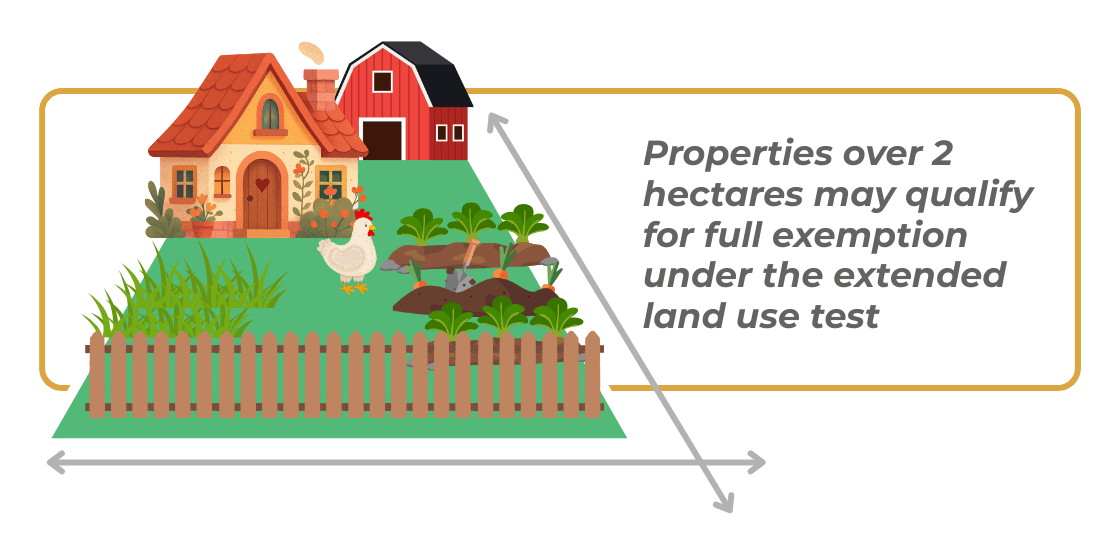
Under the standard Centrelink rules, only the first 2 hectares (roughly 5 acres) of land around your home is exempt from the assets test. Any land beyond that 2-hectare exempt area — what you'll see called "curtilage" on your Centrelink statements — is counted as an assessable asset, and for rural and semi-rural properties, can be worth hundreds of thousands of dollars. See our 5 acre rule guide for how the standard rule works.
The extended land use test (commonly known as the "20-year rule") changes that completely. If you qualify, your entire property on that title is treated as your principal home and fully exempt from the assets test — no matter how large it is.
💡 What this could mean for you
A couple on a 20-hectare rural block valued at $800,000 (with $150,000 for the house and exempt 2 hectares, $650,000 for the remaining land) could see that $650,000 completely removed from their asset count under this large property pension exemption. With the assets-test thresholds for a homeowner couple starting at — and the pension cutting off entirely at —, that's potentially the difference between no pension and a substantial part-pension.
The four requirements you must meet
To qualify for the extended land use test, you must satisfy all four of the following criteria. One member of a couple can qualify on behalf of both, but all four requirements must be met by that same person — you can't combine criteria between partners.
- Property is on a single title — All the land you want exempted must be on the same title as your principal home. Multiple titles are generally assessed separately (with limited exceptions — see below).
- You've lived there continuously for 20+ years — You must have lived on the property as your principal home for at least 20 years without a permanent break. Temporary absences of up to 12 months (sometimes longer) don't break this continuity.
- You're receiving a qualifying payment — You must be receiving Age Pension, Carer Payment, Pension Bonus Bereavement Payment, or a DVA Service Pension. Simply being of pension age isn't enough — the payment must actually be payable to you.
- Effective use is being made of the land — The land must either be used productively (by you or anyone else), or have little or no scope to earn income. This is the most flexible requirement — see the next section for details.
Three ways to pass the "effective land use" test
The effective land use requirement is more flexible than most people realise. There are three separate pathways to satisfying it, and the land doesn't have to be used by you personally.
🌾 Pathway 1: You work the land
You personally use the land to generate income. This includes running a farming operation, growing crops, running livestock, or any other productive use — even small-scale or part-time. It doesn't need to be your primary source of income.
👨👩👧 Pathway 2: Someone else works it
A family member, neighbour, tenant, or anyone else uses the land productively. This includes a son or daughter running a farm, leasing land to a neighbour for grazing, or renting paddocks to a local farmer — as long as a reasonable commercial return is received or the land is being worked to its potential.
🌿 Pathway 3: The land can't be used
The land has little or no scope to earn income. This applies to scrubby or heavily treed blocks, steep or hilly terrain, land with no water access, environmentally restricted land, or properties where council won't permit subdivision or commercial activity.
ℹ️ Key point: it doesn't have to be you
This is one of the most important — and most commonly misunderstood — aspects of the extended land use test. The requirement is that effective use is being made of the land, not that you are personally making that use. If your adult child runs the farm, if a neighbour leases your paddocks, or if you rent land to a local business, the test can still be satisfied.
What Centrelink considers when assessing your land
Services Australia takes a range of factors into account when deciding whether the effective land use test is met. Their assessment considers the individual circumstances of each case, including:
| Factor | What they look at |
|---|---|
| Location | Is the land in a farming area, rural-residential zone, or semi-rural suburb? Is it close to services? |
| Land capability | What could the land reasonably produce given its soil, water, terrain and climate? |
| Your health | Physical capacity to work the land. An 85-year-old isn't expected to run cattle. |
| Family situation | Who else lives on the property? Is a family member working it? |
| Other houses | Are there other dwellings on the title? Who lives in them? |
| Commercial use | Is any of the land leased or used commercially? What income does it produce? |
| Environmental restrictions | Are there conservation orders, heritage overlays, or land management agreements that restrict use? |
| Council restrictions | Does zoning prevent subdivision or commercial activity? |
The key principle is: are you (or someone) using the land to its reasonable potential, given all these circumstances? If yes, or if the land genuinely can't be used productively, the test is satisfied.
Real-world examples
These examples are based on scenarios published by Services Australia:
🐄 Bob — dairy farmer, 30 hectares
Bob is single, receives the Age Pension, and owns 30 hectares on a single title. He's lived there all his life and still runs it as a dairy farm.
👵 Jenny — son runs the farm, 100 hectares
Jenny is 85, receives the Age Pension, and has lived on the 100-hectare single-title farm for 40 years. She can't run the farm herself anymore. Her son John and his family live in another house on the land and John earns his living from running the farm.
🌳 Betty & Jim — scrubby block, 5 hectares
Betty and Jim both receive the Age Pension and moved to their 5-hectare, single-title rural residential block 21 years ago. The block is scrubby with no water. There's not much scope to earn income from it, and the council won't let them subdivide.
🚜 Margaret — leases paddocks to neighbour, 15 hectares
Margaret is a widow on the Age Pension. She's lived on her 15-hectare property for 25 years. She no longer keeps livestock herself, but leases three paddocks to a neighbouring farmer for grazing at a fair market rate.
Want to see a real worked example end-to-end?
Our 12-acre block case study walks through a real situation where a couple thought their property was killing their pension — and shows what changed when the 20-year rule was correctly applied.
Important exceptions and edge cases
Multiple titles
The extended land use test generally only applies to land on the same title as your home. If your property is spread across multiple titles, only the title with your house on it can qualify. However, there are limited exceptions:
- Titles combined before 9 May 2006 are treated as a single title for this test.
- Titles combined after 9 May 2006 may only qualify if merging the titles genuinely improved your capacity to earn income from the land (not just to access the exemption).
- In very limited cases, land on a separate title may be treated as part of your exempt area if your house literally cannot function as a dwelling without it (for example, if your septic system or only access road is on the other title).
Temporary absences
Being away from your property temporarily doesn't break the 20-year continuous attachment, provided the absence is genuinely temporary:
- Up to 12 months for general temporary absences (travel, hospital stays, visiting family).
- Up to 2 years in some circumstances, such as delays in home repairs outside your control.
- The property must still be your principal home — meaning you intend to return and haven't established a permanent home elsewhere.
Entering aged care
If you enter residential aged care, your former home (including land exempted under the extended land use test) retains its exempt status for the first 2 years. After that, the exemption can continue if a "protected person" (your partner, a carer who has lived there 2+ years, or a close relative who has lived there 5+ years and receives an income support payment) still lives in the home.
Couples
If one member of a couple meets all four requirements, both partners benefit from the exemption. If the couple later separates, the exemption stays with whoever remains on the property and continues to meet the effective land use test. Importantly, if the remaining partner later forms a new couple with someone else, their new partner also automatically qualifies for the exemption.
⚠️ Business assets are NOT exempt
Even when the land itself is fully exempt, any business assets on the property remain assessable. This includes livestock, farm machinery, plant and equipment, and commercially-used sheds or outbuildings. Only the land and your dwelling are covered by the extended land use test exemption.
What if you don't qualify?
If you can't meet all four requirements for the extended land use test — the most significant farm home exemption in the Centrelink system — the standard private land use test still applies. This means:
- Your house and the first 2 hectares (approximately 5 acres) of land on the same title can still be exempt, provided the land is used primarily for private or domestic purposes (not entirely for commercial purposes).
- Any land beyond 2 hectares will be counted as an assessable asset at its current market value.
For a full explanation of the standard rules, see our guide to the 5 acre (2 hectare) rule for home exemptions. And if you have excess land that doesn't qualify, it's worth understanding how that excess land is actually valued — the calculation is often more favourable than people assume.
How to apply and what to expect
There's no separate application form for the extended land use test. It's assessed as part of your Age Pension or income support claim, or as part of a property review if you're already on payment.
In practice, what most people need to provide is fairly modest:
- A copy of the title document showing you've owned the property (and confirming it's on a single title)
- A brief written explanation in your own words: when you moved in, how long you've lived there continuously, and how the land is used (whether you work it yourself, someone else does, or it can't realistically be used to earn income)
That's usually the starting point. Centrelink may come back asking for more detail on any of the four requirements — but they don't typically demand the full document trail upfront.
ℹ️ If Centrelink does ask for more
If Centrelink wants additional evidence (this is more common in borderline cases or when the property's value is significant), the kinds of things that can help include: old council rates notices, utility bills or insurance policies showing the property address going back through the period, statutory declarations from long-term neighbours, or council zoning information if you're relying on the "land can't be used" pathway. Don't preemptively dig out 20 years of paperwork — wait to see what they actually ask for.
💡 Practical tip
Keep it simple at the first pass. A clear, plain-English statement of your circumstances plus the title document is often all that's needed. If Centrelink wants more, they'll let you know — and you can produce extra evidence then. Most people overestimate how much paperwork is required for this.
Frequently asked questions
A few questions that come up regularly.
Not necessarily. Three pathways to qualify: you work the land, someone else works it (family, tenant, neighbour), or the land has little or no scope to earn income (scrubby, no water, council won't permit subdivision). Many long-term owners qualify under pathway 3 without realising. See "Three ways to pass the effective land use test" above.
No. Only the land and dwelling are exempt. Livestock, farm machinery, plant and equipment, and commercially-used outbuildings remain assessable.
What to do next
If you've lived on your rural property for 20+ years, you're receiving Age Pension or another qualifying payment, and your property is on a single title, take the time to read the four requirements carefully and think about which effective-land-use pathway applies to you. Many people who think they don't qualify actually do — particularly under pathway 3 (little or no scope to earn income). If significant amounts of pension are at stake, this is exactly the kind of situation where a coaching call pays for itself many times over.
Think you might qualify?
The extended land use test is assessed case-by-case. A coaching call can help you work out whether the four requirements are met for your specific situation — and what evidence you'll need.
Accuracy Note: Whilst every care has been taken to ensure this information is current and accurate, I am only one person and there's a very good chance I'll miss something. If you spot a factual error, or if a calculator breaks or gives an incorrect answer, I'd be really grateful if you could let me know via the Contact Us page so I can fix it as quickly as possible.
It would speed up the correction process enormously if you could cite the title of the page where you found the error and describe what the error is. Thank you for your support in keeping this resource accurate for everyone's benefit.
Disclaimer: The information on this page is general in nature only and does not take into account your individual circumstances. It is not financial advice, tax advice, or legal advice. The extended land use test involves a case-by-case assessment by Services Australia; eligibility depends on your specific circumstances. Before relying on the rule for any major decision, consult a qualified financial planner.
Primary sources: Services Australia — Rural customers and primary producers · DSS Social Security Guide — Extended land use test · DVA CLIK — Extended Land Use Test
Page last reviewed by Mary at RetirementCalculators.com.au